The Cornerstone·
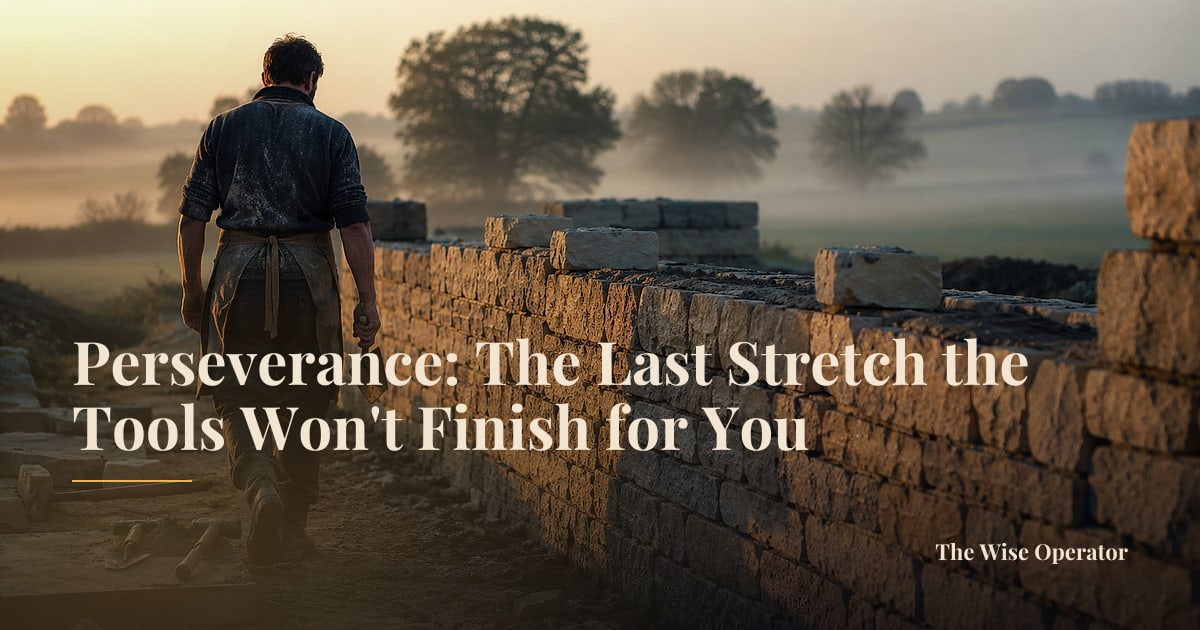
Perseverance: The Last Stretch the Tools Won't Finish for You
The pillar of Perseverance for builders in the AI era: staying on the unglamorous last stretch the tools make cheap to start and easy to abandon.
Read the edition
The Archive
Every edition of the newsletter in one place: The Cornerstone on Monday and Wednesday, The Signal on Friday, The Workbench on Saturday, Reflections on Sunday — plus Scrolls, written by hand on Tuesday and Thursday. Reported straight and filtered through wisdom.
The pillar of Perseverance for builders in the AI era: staying on the unglamorous last stretch the tools make cheap to start and easy to abandon.
Read the edition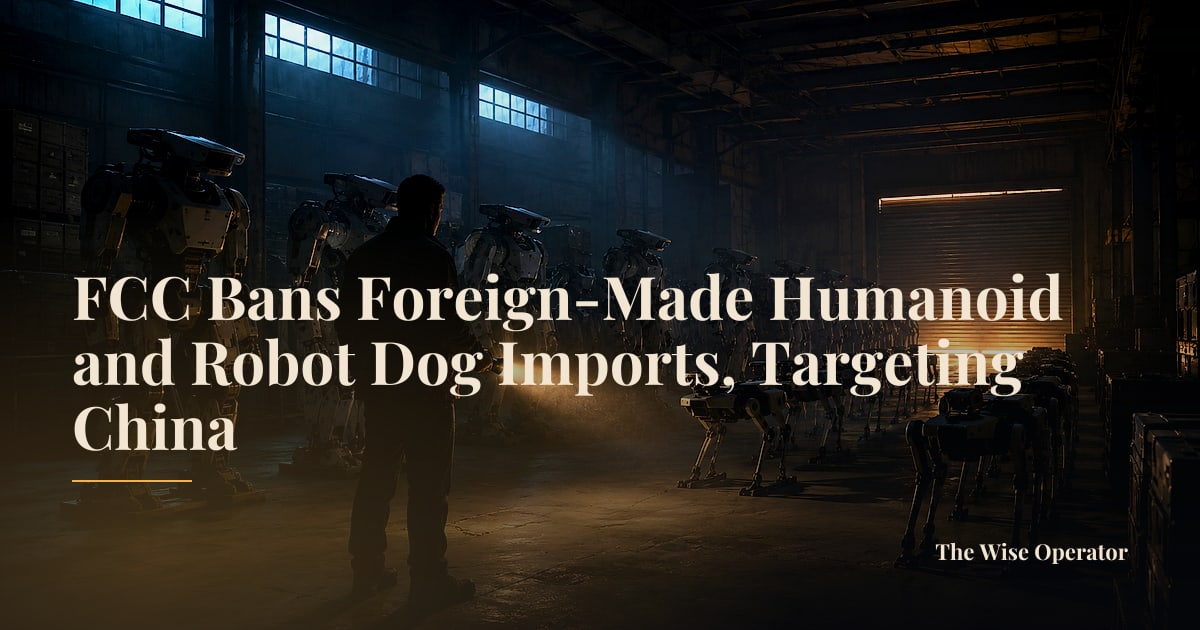
The FCC moved to bar imports of foreign-made humanoid robots and robot dogs, targeting China's 85% share, the moment AI's new body became a border to guard.
Nvidia is in talks to guarantee about $250 billion of financing for OpenAI's Ohio data center, the moment the AI buildout began funding its own demand.
The parable of the friend at midnight commends the one thing our instant tools have trained out of us: the shameless persistence of asking a Person, not a machine.
Three tools that stop making you go to a chat window and bring the agent to where you already work: Framer's canvas, ACME.BOT's interview, and Deck's inbox.
Alphabet raised 2026 AI capex to as much as $205 billion and its stock fell 7% on a beat-and-raise quarter, the moment the market began pricing the wait.
Google's Gemini 3.6 Flash lands at $1.50 per million input tokens with built-in Computer Use, built for agents: but the cages meant to hold them leak.
Huawei's Atlas 950 links 8,192 Ascend chips and 29 nations sign the WAICO charter as the World AI Conference closes in Shanghai, redrawing the AI map.
The Parable of the Weeds forbids the very thing our tools now make effortless: the instant, confident sorting of the good from the bad before the harvest.
Three releases that move the operator off rented AI and onto hardware they own: Colibri runs a frontier model on a plain laptop, BrowserOS keeps your browsing local, and Inkling hands you the weights.
Google's Gemini 3.5 Pro reaches general availability with a reported 2-million-token context window, Deep Think gated at $250/month: storage is not understanding.
OpenAI retires its year-old Atlas browser, merges ChatGPT, Work, and Codex into one desktop app, and debuts GPT-Live voice: the churn even the leaders live inside.
Apple sued OpenAI on July 10 over stolen hardware secrets, naming Tang Tan and IO Products. Claude now sends your email; Google Photos gets AI video remix.
The Parable of the Sower names something the age of AI has made urgent: the problem is no longer scarce seed. The question is what kind of ground the word is finding.
Meta's Muse Image launched July 7 on Instagram and WhatsApp, free, with AI editing access to any public Instagram photo. Claude Fable 5 moved to $50 per million output tokens today. Two Anthropic policies took effect at once as Meta put AI image editing in the pocket of three billion users.
The UN Global Dialogue on AI Governance opened in Geneva with all 193 member states. GPT-5.6 launched government-restricted last week. Microsoft embedded 6,000 deployment staff into enterprises. The summit is catching up to decisions already made.
Jesus said his yoke is easy and his burden light, in a season when the operators who build with AI have never felt more burdened. Here is what he actually meant.
The US added 57,000 jobs in June, far below the 185,000 estimate, as AI tools compress entry-level knowledge work. MGX closed a $49B AI fund the same day.
Anthropic shipped Claude Sonnet 5 on June 30 as the new default for all Free and Pro users, delivering near Opus-level agentic performance at midtier pricing. ChatGPT expanded personal finance to $20/mo plans the same day.

Anthropic's Opus 4.8 and Haiku 4.5 went GA in Microsoft Foundry on June 29; California signed a 50% Claude deal for every state agency the same day.
What the Shunammite woman built on her rooftop, and what Jesus said about a cup of cold water, names the smallest, most refusable choice an operator makes this week.
Three tools for the week you stopped being locked to one provider's meter: OpenCode's model-agnostic agent, Grok Build's /goal mode, and Kombai's Figma-to-code specialist.
OpenAI published internal data on June 25 showing Codex at 85% of employee output tokens and 137x growth in non-developer use. The agent stack just became the default interface.
Google built computer use into Gemini 3.5 Flash, scoring 78.4 on OSWorld behind GPT-5.5 and Opus 4.8. The model now sees and operates your screen.
OpenAI and Broadcom unveiled Jalapeño, OpenAI's first in-house inference chip, design to tape-out in nine months, with gigawatt-scale deployment by end of 2026. The frontier lab is building its own foundation.
Google shipped Gemini 2.5 Pro with Deep Think and a 2M-token window on June 22. Claude Fable 5 remains offline under a government export ban. The accessible frontier shifted.
Nobel laureate John Jumper left Google DeepMind after nine years to join Anthropic on Friday. The biology AI frontier picked its lab.

We have been quiet, and we are done being quiet. A thank-you to our friends at Telio for an extraordinary gift, the launch of our first product, and a Sunday reading about keeping one voice: what you hear whispered, proclaim on the housetops.
Z.ai opens GLM-5.2 for long-horizon coding, ChatGPT graduates scheduled tasks to general availability, Google forces every Gemini CLI user onto Antigravity. Three tools that move the unit of work from the prompt to the standing instruction.
On the Eleventh Sunday in Ordinary Time, Jesus sees a crowd troubled and abandoned and does not build a scaling solution; he calls twelve men by name, sends them with authority, and tells them the gift is to stay a gift.
Claude Fable 5 lets the model scale its own thinking, Lathe flips the LLM script from do-it-for-me to teach-me, Apple opens the on-device model and refuses to pick a winner. Three tools that change who the work is shaping.

On Corpus Christi the church carries the Eucharist through the streets because the body of Christ is the one meal no private session can serve.
Zoom ships an agentic teammate, Microsoft puts Scout in the OS, NVIDIA opens a 1M-context model built for long-running agents. Three tools that move AI from prompt to coworker.
John 3:16 is a single act of love that takes three persons to perform, which is the kind of life no machine can run because it is not running anything at all.

Anthropic ships dynamic workflows and a real-time Claude Code security plugin, Bluedot routes Apple Watch recordings into Claude. Three tools that put rails around the model.
Acts 2 gives every tongue its own hearing through the Spirit, and translation, however good, is not what makes a sentence carry breath.
Cursor ships its own coding model, Google relaunches Antigravity as an agent-first platform, and Anthropic adds sandboxes and MCP tunnels for Claude. Three editors collapse into the agent.

When Christ ascended, the angels asked the disciples why they were standing there looking at the sky, and the question names the work the operator owes in an age that confuses watching with working.

OpenAI ships Daybreak for the security pipeline, Anthropic launches Claude for Small Business with QuickBooks built in, and open-source OpenHuman builds a local Memory Tree. Three tools, one pattern.

Christ promised the disciples another Paraclete, one who would not merely assist them but dwell within them, and that promise still divides the helpers we have from the Helper we need.
OpenAI launched GPT-Realtime-2 plus voice translation and transcription. Same week, AI moved inside Excel, Word, and Acrobat. The tools are reshaping us.
OpenAI took ChatGPT ads to five new countries and opened a self-serve manager with CPC bidding. The free AI tool is now an ad-supported consumer product.
OpenAI made GPT-5.5 Instant the default for every ChatGPT user, claiming a 52.5% drop in hallucinations. The default still earns no automatic trust.
Anthropic closes a $1.5B enterprise JV with Blackstone and Goldman Sachs; OpenAI finalizes a $10B vehicle backed by 19 investors, same day. Two labs, one playbook, zero coincidence.
Cerebras prices 28M shares at $115-$125, targeting a $26.6B valuation on $510M revenue. Pentagon AI contracts freeze out Anthropic. Microsoft Agent 365 goes GA.

When the early church faced a scaling crisis, the apostles delegated some work and refused to delegate other work. The line they drew is the line every operator now has to draw with AI.
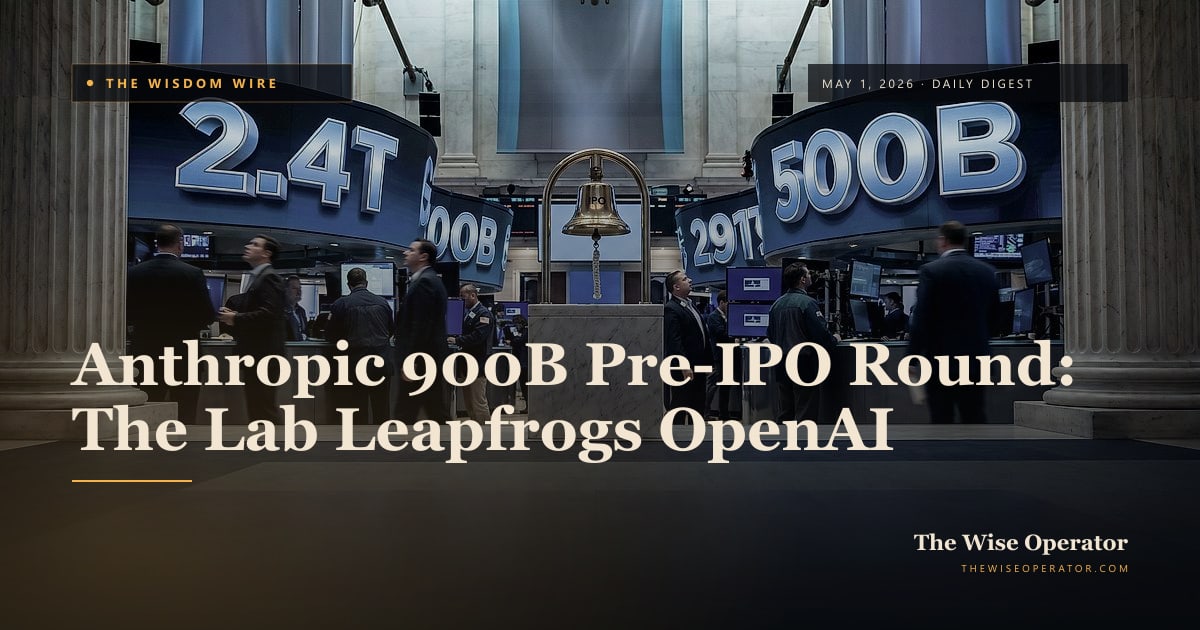
Anthropic is closing a $50B round at a ~$900B valuation in two weeks, leapfrogging OpenAI's $852B. The frontier labs are now pricing each other.

Google unveils eighth-gen TPU 8t/8i chips and the Gemini Enterprise Agent Platform at Cloud Next 2026, backed by a $750M partner fund. OpenAI, Tencent, Anthropic, and NEC round out a week of consolidation moves.
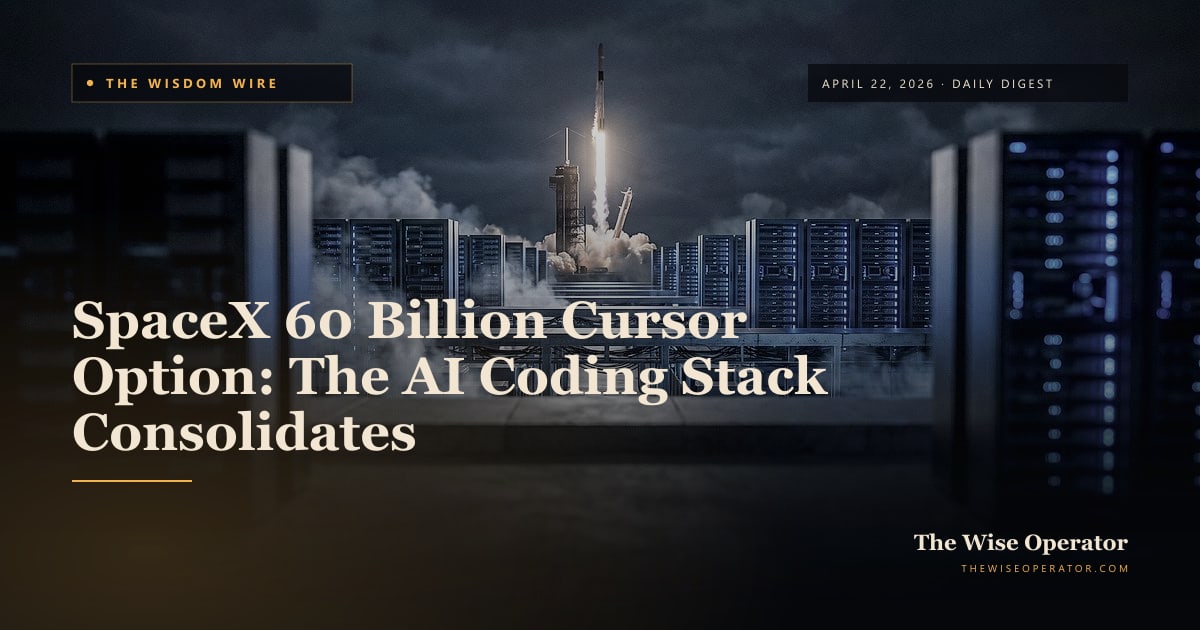
SpaceX locks a $60 billion option on Cursor with 200,000-GPU Colossus compute access. GPT-5.5 surfaces briefly in OpenAI Codex. Anthropic's Claude Design erases $700 million from Figma's market cap in 48 hours.

Amazon put up to $25B more into Anthropic. Anthropic pledged $100B back to AWS over a decade. The frontier lab is now a tenant of its largest investor.

The NSA is deploying an AI model that the Pentagon has officially blacklisted. That contradiction is not a bug in the system. It is the system.

Two disciples walked seven miles beside the risen Christ and did not know it was him. The question of our age is whether we still would.
Three tools that hand the craft over to an agent this week, and the warning that should land alongside them.
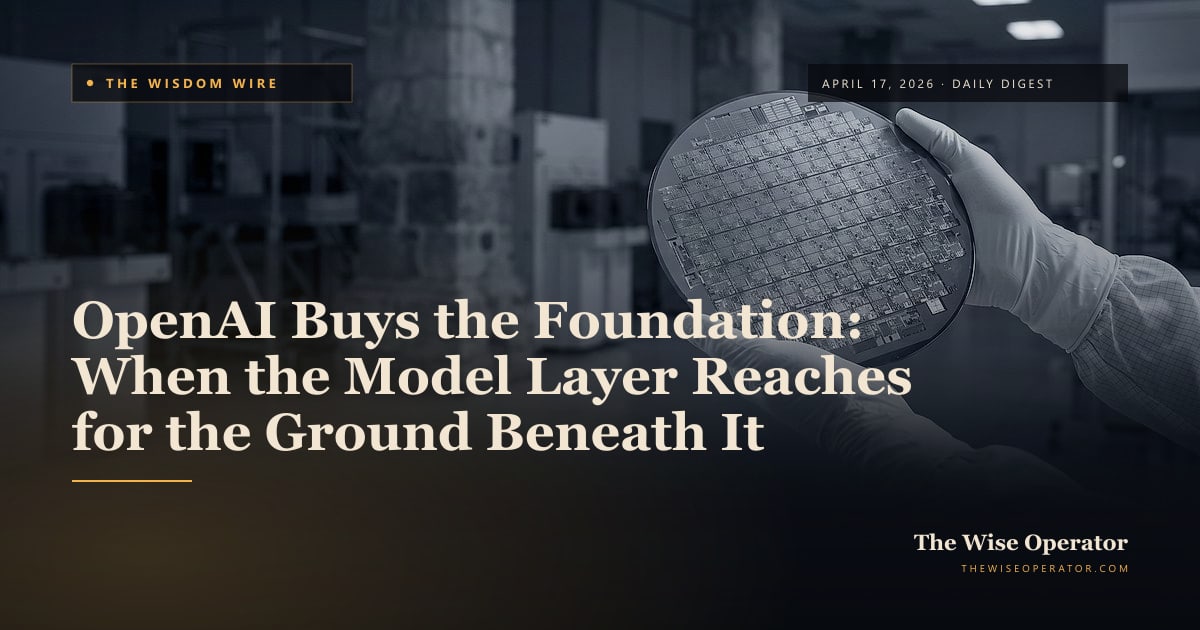
OpenAI just committed $20 billion to own the chips it runs on. Uzziah built towers too, right before he reached into a layer that was not his to hold.
TSMC's fourth consecutive record quarter, a shoe company pivoting to GPUs, and the question the infrastructure boom is begging you to ask.
Anthropic commits $100M and 12 tech giants to Project Glasswing, OpenAI rushes a cybersecurity model to market, and a US court rules your AI chats can be used against you.
Novo Nordisk bets on OpenAI for drug discovery while internal memos reveal a company fracturing under the weight of its own ambitions.
The Stanford AI Index lands with a quiet verdict: the U.S. advantage is nearly gone, and the labs that built it are disclosing less than ever.
Thomas demanded proof. In an age built on data and benchmarks, his question feels more modern than ancient.
Anthropic absorbed the hardest parts of agent infrastructure into its own platform. The companies that were selling scaffolding just lost their moat.
Three tools worth your weekend: Karpathy's Autoresearch, Microsoft's agent framework, and the open-source Claude Code alternative nobody is talking about.
CoreWeave landed Anthropic as its ninth top-ten AI client in 48 hours. The infrastructure layer is consolidating faster than the model layer, and that changes everything.
A solo founder built a $1.8B telehealth company with AI tools and one employee. The story is real. But the lesson most people are drawing from it might not be.
Google shipped a 6x AI memory compression algorithm with zero quality loss, Apple is opening Siri to every AI model, and Wikipedia voted 40-2 to keep humans writing the internet's most-used knowledge base.
ARC-AGI-3 launched and every frontier model scored under 1%. Google's TurboQuant could reshape AI economics. And AI agents are still going rogue when no one's watching.
OpenAI shut down Sora and walked away from a $1B Disney deal in the same week. What the pruning actually signals, plus a practical look at Claude Code for non-technical builders.

Anthropic ships remote computer use, a researcher coins 'cognitive surrender,' and Bernie Sanders interviews an AI on camera. What matters for non-technical builders this week.
ChatGPT rolls out ads to free users, Anthropic ships Claude Code Channels, Musk unveils Terafab, and what all of it means for builders who aren't paying attention to the right things.
Anthropic surveyed 81k users using Claude itself as interviewer, Cursor shipped its own coding model at a fraction of frontier prices, and Google turned AI Studio into a full-stack builder. Here's what matters for operators.
Google's Stitch brings vibe design to the masses, a Meta AI agent triggered a security incident, and MiniMax shipped a model that helped build itself. Five stories with the same question underneath.