Sunday Reflection
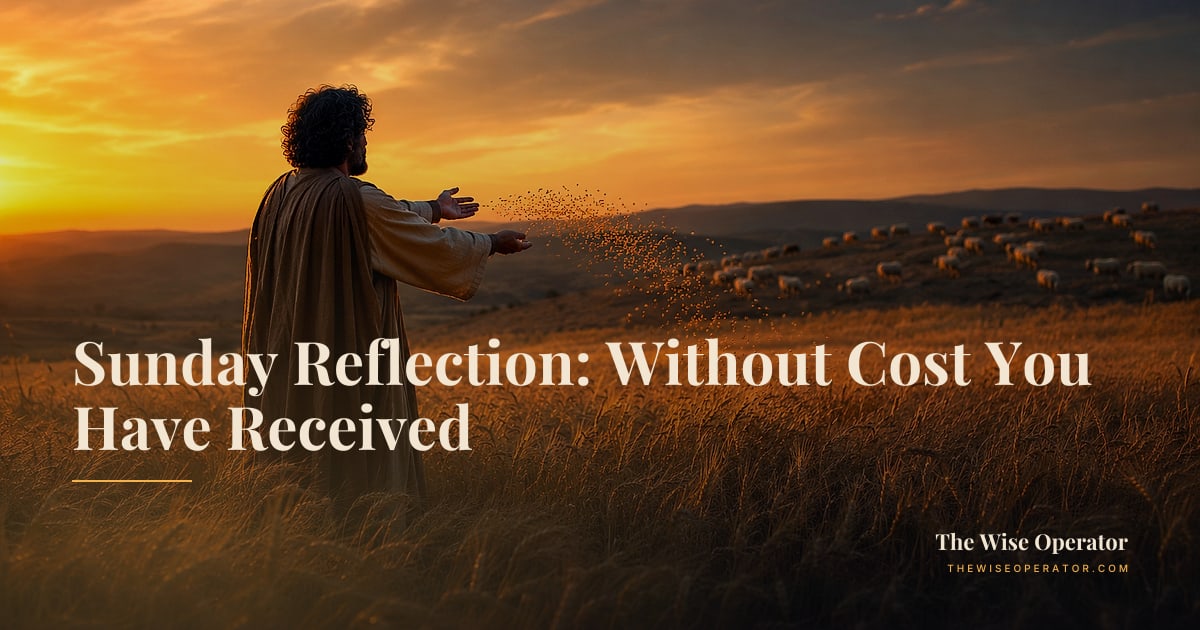
Sunday Reflection: Without Cost You Have Received
On the Eleventh Sunday in Ordinary Time, Jesus sees a crowd troubled and abandoned and does not build a scaling solution; he calls twelve men by name, sends them with authority, and tells them the gift is to stay a gift.
By Scott Krukowski, editor of The Wise Operator
Each Sunday, The Wise Operator steps away from the news to sit with Scripture and ask what ancient wisdom means in the age of AI.
It is Sunday. The week’s noise can wait. Today the church reads the passage that every executive deck about labor scarcity reaches for and quietly mishandles. The harvest is abundant. The laborers are few. The line is older than the modern complaint about productivity by two thousand years, and Jesus answers it in a way no quarterly plan ever quite manages to copy.
This Week’s Reading: Matthew 9:36-10:8
“At the sight of the crowds, Jesus’ heart was moved with pity for them because they were troubled and abandoned, like sheep without a shepherd. Then he said to his disciples, ‘The harvest is abundant but the laborers are few; so ask the master of the harvest to send out laborers for his harvest.’ Then he summoned his twelve disciples and gave them authority over unclean spirits to drive them out and to cure every disease and every illness. The names of the twelve apostles are these: first, Simon called Peter, and his brother Andrew; James, the son of Zebedee, and his brother John; Philip and Bartholomew, Thomas and Matthew the tax collector; James, the son of Alphaeus, and Thaddeus; Simon the Cananean, and Judas Iscariot who betrayed him. Jesus sent out these twelve after instructing them thus, ‘Do not go into pagan territory or enter a Samaritan town. Go rather to the lost sheep of the house of Israel. As you go, make this proclamation: The kingdom of heaven is at hand. Cure the sick, raise the dead, cleanse lepers, drive out demons. Without cost you have received; without cost you are to give.’” Matthew 9:36-10:8, NABRE
What This Means in the Age of AI
The first thing to notice is what Jesus does not do. He sees a crowd that is troubled and abandoned. The verb Matthew uses for his reaction is splagchnizomai, a gut-level word that means his insides turned over. A modern reader expects what follows to be a system. A platform. A solution that can be cloned, packaged, and shipped to scale. What follows instead is a list of twelve men’s names, and the inclusion of the one who will betray him. Specificity, not abstraction. Vocation, not headcount.
The harvest-laborer ratio is real, and it has been real since the world was old. The fields in Galilee in the first century were larger than the families who worked them. The kingdom of heaven is larger still. Every generation has stood in the same gap. The temptation in our generation is to think a sufficiently capable tool, deployed at sufficient density, can finally close it. The Gospel will not let us think this. The master of the harvest is asked to send out laborers, not implements. The verb is to send, and the noun is to be a person who can be sent.
The commission Jesus gives the twelve is concrete and physical. Cure the sick. Raise the dead. Cleanse lepers. Drive out demons. None of these can be done from a distance. The leper has to be touched, which the Mosaic law forbade and which Jesus did anyway. The dead have to be approached. The demon has to be named. The sick need someone in the room. The kingdom of heaven, as the apostles announce it, is at hand because they brought their hands.
Then comes the line that should slow every operator down. Without cost you have received; without cost you are to give. In the Greek it is one word twice, dorean dorean. As a gift you have received it; as a gift you are to hand it on. Jesus has just given the twelve real authority, the kind that can cast out a demon, and in the same breath he tells them the authority is not theirs to monetize. They did not earn it. They cannot price it. The structure of the gift forbids the structure of the market.
This is the place where the age of AI gets uncomfortable. The corpus on which every modern model is trained is the same word twice: it was received, mostly without cost, from the writing of every person who has ever published anything. Whether the gift is allowed to remain a gift, or whether it is renamed and resold at a margin, is the defining decision of this decade. There is a kind of work in your week that you cannot in good conscience price. Find it. Do it anyway. Receive what was given to you as a gift, and pass it on under the same terms.
Carry this into the week. Use the tools. Let them do the work they are good at, which is the work no person actually misses doing. But somewhere in your week, name twelve specific people the way Jesus named his twelve. Not a market, not a funnel, not a list of leads. Twelve faces. Then go to them with your hands free, because what was given to you as a gift was given so it would not stop with you. And keep watch on the warning hidden in the same sentence: anything that could have been a gift, but got renamed as mammon along the way, has already lost the authority it was meant to carry.
The Other Readings
The First Reading (Exodus 19:2-6a) places Israel at the foot of Sinai, where the LORD tells Moses that the people he bore “on eagles’ wings” will be his treasured possession among all peoples, “a kingdom of priests, a holy nation,” the verse the apostle Peter will pick up centuries later to describe the church. The Responsorial Psalm (Psalm 100) answers with the antiphon every congregation will sing this Sunday, “We are his people, the sheep of his flock,” the exact sheep Jesus pities at the opening of today’s Gospel. The Second Reading (Romans 5:6-11) sets the doctrinal floor under the Gospel’s mission: “while we were still sinners Christ died for us,” the original gift without cost from which every later sending takes its authority.
A Closing Prayer
Lord Jesus Christ, master of the harvest, you did not answer the size of the crowd with the size of a system. You called twelve by name, you sent them with your authority, and you bound the authority to the gift it came from. Steady my hands on the work you have given me, free me from the temptation to price what was meant to be given, and let me carry your name into the rooms only my particular life can enter. Amen.
From the Editor
Got a half-formed idea you want to put to work? Let's sharpen it into a build plan.
Prototype Your IdeaA short interview that turns your idea into a structured build plan. Takes about five minutes.