The Wire
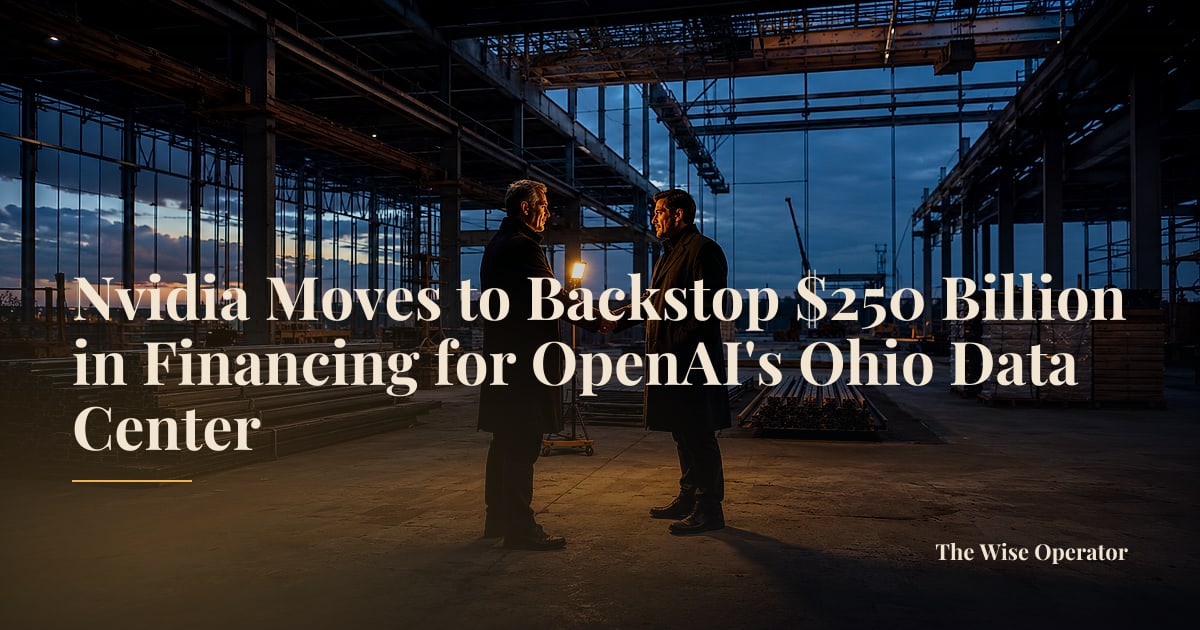
Nvidia Moves to Backstop $250 Billion in Financing for OpenAI's Ohio Data Center
Nvidia is in talks to guarantee about $250 billion of financing for OpenAI's Ohio data center, the moment the AI buildout began funding its own demand.
By Scott Krukowski, editor of The Wise Operator
For three years the AI buildout ran on a clean division of labor. Labs raised money, bought chips from Nvidia, and rented the data centers to run them from Microsoft, Amazon, and Oracle. This week that line began to bend into a circle. The company that sells the chips is now offering to guarantee the debt its largest customer needs in order to keep buying them.
When the seller underwrites the buyer, their fortunes stop being separate and become one balance sheet. The biggest version of that arrangement yet surfaced this week in a field in Ohio.
The Lead: Nvidia Moves to Backstop $250 Billion in OpenAI’s Ohio Data Center
Nvidia is in talks to guarantee roughly $250 billion of financing tied to a 10-gigawatt data center that OpenAI is building on a former uranium-enrichment site about 50 miles south of Columbus, Ohio.
The guarantee is a form of vendor financing: OpenAI lacks an investment-grade credit rating, so Nvidia’s backing is what lets it secure favorable terms on the lease and construction debt. The site is being developed with SoftBank’s energy unit, with a first 800-megawatt phase due in 2028 and total project cost expected to run past $500 billion across phases. It marks OpenAI’s first real move to own its compute rather than rent it, and it is a large one.
Nvidia is separately weighing up to $350 billion more to help finance OpenAI’s purchases of Nvidia chips, which is where the circle closes: the chipmaker funds the customer, the customer buys the chips, the chipmaker books the sale. Investor Michael Burry mocked the loop plainly, “around and around we go.” The mechanism it most resembles is the compute commitment, the multi-year spending pledge that already ties labs and cloud providers together, now extended one link further, to the silicon itself.
For the operator watching from below, the signal is not that the deal is reckless. It is that the AI boom has grown large enough that its biggest supplier would rather underwrite demand than wait for it, a posture that works beautifully until the borrower stumbles, according to people familiar with the talks (Yahoo Finance).
What It Means for You
The same circular money that pours the concrete in Ohio is quietly shipping you a cheaper assistant, a faster phone, and a kitchen that finally understands you this week.
Anthropic released Claude Opus 5 on July 24, now the default model on its Max plan and priced the same as before at $5 and $25 per million tokens. Its headline feature is an effort dial you set per request, low, medium, or high, that trades capability for cost so a routine question does not burn the tokens a hard one needs. It lands close to the pricier Claude Fable 5 at roughly half the cost, with a one-million-token context window.
That same bargain between cost and capability is being struck on your phone, more quietly. Apple’s iOS 26.6, rolling out around today, begins building an on-device semantic index of your messages, photos, and email, a meaning-based map the revamped Siri in iOS 27 will need to answer personal questions. Doing the slow work now means next year’s upgrade takes hours instead of a week.
The pattern reaches the kitchen, too. Amazon’s Alexa+ upgrade can now parse a tangled spoken request, read a garment tag and pick the right washer cycle, then route the command to the correct device, and it stays free for the 180 million US Prime members who already pay for it. The intelligence funded upstream keeps arriving downstream as ordinary convenience.
“The boom you read about in billions arrives at your door as a dial, an index, and a washing machine that finally reads the tag.”
What’s Moving Underneath
Underneath the consumer polish, the models themselves kept getting larger and stranger. China’s Moonshot AI published the full open weights for Kimi K3 today on Hugging Face, a 2.8-trillion-parameter model, the largest ever released openly, under a modified MIT license that lets almost anyone build on it. The catch is scale: roughly 50 billion parameters activate per token, and even squeezed to 4-bit precision it needs about 1.4 terabytes of fast memory before you add any context, which keeps it out of all but the best-funded hands (VentureBeat).
Elon Musk answered with a roadmap rather than a release, posting that xAI would ship Grok 4.6 in two weeks and Grok 4.7 in four, and claiming Grok 4.5 already sits alongside Claude Opus 5 on the performance frontier. Those numbers are Musk’s own and remain unverified by any independent benchmark, so read them as a pace of promises, not proof.
“One lab hands its largest model to the world; another lends its customer the money to keep the best compute for itself.”
Set beside the Ohio guarantee, the frontier is now being pushed from two directions: a Chinese lab giving its largest model away, and an American one financing the compute to keep its own scarce. None of it reaches your screen this week. All of it is the scaffolding, and the balance sheet, that will decide what reaches you next year.
One Tool Worth Knowing
The effort dial is the rare AI feature aimed at your bill rather than your imagination. It lets you tell the model how hard to think on a given request, low for routine drafting and lookups, high for the genuinely difficult reasoning, so you stop paying frontier prices for lightweight work. Because it costs the same per token as before and reaches near the top of Anthropic’s range, the savings come entirely from not overspending capability you did not need.
To use it without touching code, make low your default inside Claude for summaries, rewrites, and quick questions, and reserve high for the one or two problems a day that genuinely require deep reasoning, watching your token use settle as you do. If you build, wire the effort setting into your API calls through a model routing layer, so routine agent steps run at low effort and only the hard step in a chain escalates, which is where most of a runaway bill hides.
Wisdom Speaks
“A man void of understanding strikes hands, and becomes collateral in the presence of his neighbor.” Proverbs 17:18, WEB
In the ancient world, striking hands was the physical act of sealing a guarantee, a clasp that made one person answerable for another’s debt. It is precisely what Nvidia proposes in Ohio: to backstop some $250 billion so that OpenAI, a borrower with no investment-grade rating, keeps buying Nvidia’s chips. The proverb does not merely warn against the risk; it names the folly, the guarantor “becomes collateral” himself, his own security now pledged to a neighbor’s ability to pay. That is the circular loop Burry mocked, and it is why the wise, per counting the cost, reckon the whole chain before they clasp the hand.
The deeper question the proverb presses is not whether to guarantee a deal but where an operator finally plants his security. Leverage can multiply a good position and it can just as fast bind you to a fall that was never yours. The one whose footing is in Christ rather than in the strength of his collateral can lend a hand, or withhold it, as wisdom asks, because his security was never in the deal to begin with.
Friday’s digest: Alphabet lifts 2026 AI capex toward $205 billion, on the market repricing the cost of the AI buildout. Earlier: Google prices agentic AI at $1.50 per million tokens, on the race to make agents cheap enough to run all day. Today’s $250 billion guarantee is the same buildout seen from the balance sheet: when the pour grows this large, the chipmaker starts underwriting the demand for its own chips.
From the Editor
Got a half-formed idea you want to put to work? Let's sharpen it into a build plan.
Prototype Your IdeaA short interview that turns your idea into a structured build plan. Takes about five minutes.