
The Wire
Alphabet Lifts 2026 AI Capex Toward $205 Billion as Its Stock Falls 7%
Alphabet raised 2026 AI capex to as much as $205 billion and its stock fell 7% on a beat-and-raise quarter, the moment the market began pricing the wait.
By Scott Krukowski, editor of The Wise Operator
There is a point in every building boom when the spending stops reading as ambition and starts reading as exposure. For two years the market rewarded every AI company that promised to pour more into compute, and the checks only got bigger. This week that reflex cracked. A company can now beat every estimate on the quarter and still be punished for what it intends to spend next year.
The number that did it belongs to one of the most profitable companies on earth.
The Lead: Alphabet Lifts 2026 AI Capex Toward $205 Billion as Its Stock Falls
Alphabet beat second-quarter estimates and grew Google Cloud 82 percent, then watched its stock fall about 7 percent when it raised 2026 capital spending to as much as $205 billion.
Revenue climbed 24 percent to roughly $119.8 billion, the kind of quarter that usually lifts a stock. Investors looked past it to one line in the guidance. Alphabet raised its 2026 AI capex range from $180 to $190 billion up to $195 to $205 billion, and that single revision pushed quarterly free cash flow into the negative.
The worry is timing, not capability. The money for data centers, chips, and power goes out now, while the revenue those frontier models are meant to earn arrives over years. When a company spends more than it takes in to build capacity for a payoff it cannot yet show, the market reprices the wait, and a 7 percent drop on a beat-and-raise quarter is what that repricing looks like.
For the operator watching from below, the lesson is not that Alphabet overspent. It is that even the strongest balance sheet now has to answer for the gap between the pour and the payoff, and the crowd has started to ask early (CNBC).
What It Means for You
The same buildout that rattled investors is what puts a talking, task-doing assistant into your kitchen, your desktop, and your medical records this week.
OpenAI opened ChatGPT Health to every logged-in US adult, letting you connect health records and Apple Health data, track test-result trends, and prepare questions before a doctor visit. That is the assistant moving from answering questions to holding the file.
The same shift shows up in how you talk to these tools. OpenAI brought its newest voice mode to the ChatGPT desktop app for ongoing, hands-free conversations aimed at real work rather than quick lookups. Anthropic answered by upgrading Claude’s voice to run on its Opus and Sonnet models, so a spoken exchange can carry longer reasoning, and letting you trigger actions in Gmail, Calendar, Slack, and Notion by voice.
Google, meanwhile, widened Gemini for Home memory to 15 minutes so a follow-up question keeps its thread, and pushed Gemini Live down to first-generation Home Mini and Nest Hub speakers. Three companies, one direction: the assistant is learning to listen, to remember, and to act.
“The assistant stopped being a search box the moment it could hold your records, keep your calendar, and follow a fifteen-minute train of thought.”
What’s Moving Underneath
Under the consumer polish, the money and the plumbing kept moving. Etched raised $300 million at a $10.3 billion valuation, roughly double its worth a year ago, for an inference ASIC that hardcodes transformer attention into silicon and claims a large speedup over Nvidia’s H100.
OpenAI, not content to sell only to consumers, launched Presence, an enterprise product for building and running realtime voice and chat agents across support, sales, and IT, aimed squarely at Microsoft and Salesforce. And DeepSeek retires its legacy model names today, forcing developers onto V4 IDs whose aggressive per-token pricing keeps setting the industry’s price floor.
None of these three reaches your screen this week. Together they are the cost curve, the sales channel, and the price floor that will decide what your assistant can do next year, and what it costs.
“A faster chip, a new sales channel, and a lower price floor: the three quiet levers that set next year’s bill.”
One Tool Worth Knowing
Anthropic’s voice mode now runs on its Opus and Sonnet models, not only the lighter Haiku, which means you can think out loud with it on a real problem instead of barking short commands at it. The part that matters for daily work is the cross-app action: by voice, you can have it draft in Gmail, block time on Google Calendar, or post into Slack, Canva, and Notion.
To try it without touching code, open Claude’s voice mode on your phone during a commute and walk it through one real task, like clearing your calendar for a focus block, then check what it actually changed before trusting it with more. If you do write code, wire the same voice-to-action layer into tools you already trust through the model’s tool-use API, so a spoken instruction fires a script you can inspect rather than a black-box action you cannot.
Wisdom Speaks
“For which of you, desiring to build a tower, doesn’t first sit down and count the cost, to see if he has enough to complete it? Or perhaps, when he has laid a foundation, and is not able to finish, everyone who sees begins to mock him, saying, ‘This man began to build, and wasn’t able to finish.’” Luke 14:28-30, WEB
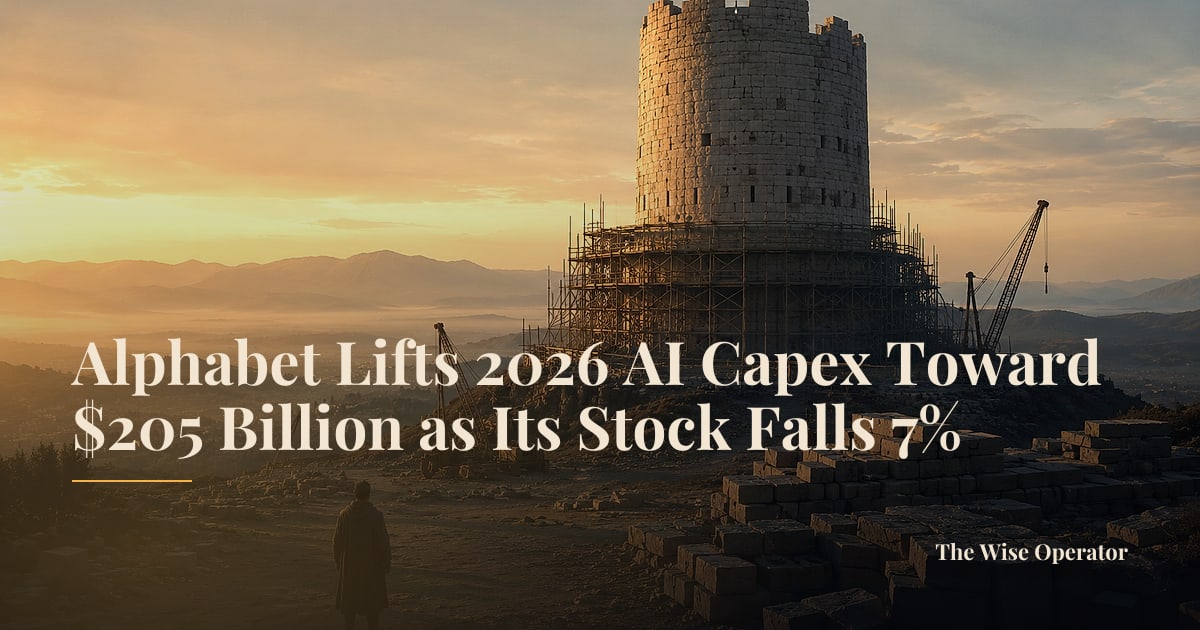
Jesus points to a builder who sits down and counts before laying a stone, so he is not left with a half-finished tower and a watching crowd that mocks the man who could not finish. That is Alphabet’s week in a single image: a $205 billion pour into compute whose payoff sits years out, with investors already uneasy about the near-term margin. The parable does not condemn the building. It names the specific danger of beginning a great work you cannot visibly complete.
The harder virtue the parable assumes is hupomone, the patient endurance to stay under a load long enough to finish what the counting approved. Counting the cost is the arithmetic before the first stone; hupomone is the steadiness through the long middle, when the foundation is poured, the roofline is nowhere in sight, and the crowd has already begun to talk.
The operator’s question under all the AI capex is not whether to build. It is whether the counting was honest before the foundation was laid, and whether there is endurance enough to finish once the mockery starts.
Wednesday’s digest: Google prices agentic AI at $1.50 per million tokens, on the race to make agents cheap enough to run all day. Earlier this week: Huawei’s Atlas 950 and the WAIC charter, on China’s drive to build its own AI compute. Today’s $205 billion capex question is the flip side of both: the same buildout that keeps pushing token prices down is the one now testing how long investors will fund the pour before the payoff shows.
From the Editor
Got a half-formed idea you want to put to work? Let's sharpen it into a build plan.
Prototype Your IdeaA short interview that turns your idea into a structured build plan. Takes about five minutes.