Sunday Reflection
Sunday Reflection: Teach Us to Ask
The parable of the friend at midnight commends the one thing our instant tools have trained out of us: the shameless persistence of asking a Person, not a machine.
By Scott Krukowski, editor of The Wise Operator
Each Sunday, The Wise Operator steps away from the news to sit with Scripture and ask what ancient wisdom means in the age of AI.
It is Sunday, and there is nothing to look up. Six days a week the work is to get answers: to put a question in and receive a result, faster every year, until the gap between wanting to know and knowing has nearly closed. This morning asks for the older kind of asking. The kind that is not a search but a prayer, and that does not always answer on the first try.
This Week’s Reading: Lord, Teach Us to Pray
From Luke 11:1-13:
When he finished praying in a certain place, one of his disciples said to him, “Lord, teach us to pray, just as John also taught his disciples.” He said to them, “When you pray, say, ‘Our Father in heaven, may your name be kept holy. May your Kingdom come. May your will be done on earth, as it is in heaven. Give us day by day our daily bread. Forgive us our sins, for we ourselves also forgive everyone who is indebted to us. Bring us not into temptation, but deliver us from the evil one.’”
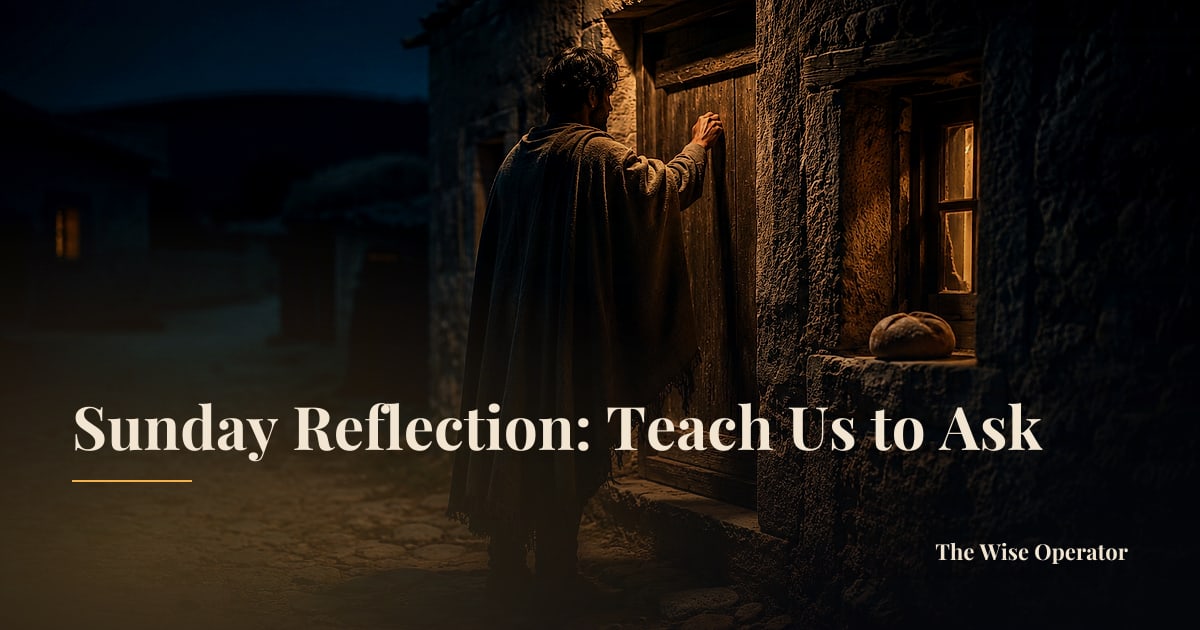
He said to them, “Which of you, if you go to a friend at midnight and tell him, ‘Friend, lend me three loaves of bread, for a friend of mine has come to me from a journey, and I have nothing to set before him,’ and he from within will answer and say, ‘Don’t bother me. The door is now shut, and my children are with me in bed. I can’t get up and give it to you’? I tell you, although he will not rise and give it to him because he is his friend, yet because of his persistence, he will get up and give him as many as he needs.
“I tell you, keep asking, and it will be given you. Keep seeking, and you will find. Keep knocking, and it will be opened to you. For everyone who asks receives. He who seeks finds. To him who knocks it will be opened. Which of you fathers, if your son asks for bread, will give him a stone? Or if he asks for a fish, he won’t give him a snake instead of a fish, will he? Or if he asks for an egg, he won’t give him a scorpion, will he? If you then, being evil, know how to give good gifts to your children, how much more will your heavenly Father give the Holy Spirit to those who ask him?”
What This Means in the Age of AI
The disciples had watched Jesus pray for a long time before they asked him to teach them. They did not want a definition of prayer. They wanted the thing itself, the way an apprentice asks a master to put the tool in his hand. “Lord, teach us to pray.” It is a request to be taught how to ask.
What is strange to a modern ear is that almost all of Jesus’ answer is about not being answered at once. The prayer he gives is short and plain. Then he tells a small story about a man who pounds on a neighbor’s door at midnight and refuses to leave until the neighbor gets up. Then come the words we know: keep asking, keep seeking, keep knocking. In the Greek the verbs are continuous. Not ask once, but keep asking. The whole teaching assumes a door that does not open on the first knock.
We are the first people to build a servant that always opens on the first knock. Put the question in, and the answer returns in a second, complete, without a pause and without a face. This is a real good, and worth gratitude. But it trains a habit that is quiet and total. We begin to expect that every ask is a query, that every query returns a result, and that the space between wanting and having should close as fast as the machine can close it. The friction Jesus builds into prayer, the midnight and the shut door and the sleeping children and the second knock, is precisely the friction our tools exist to remove.
So it is worth asking what the friction was for. The friend at the door does not get his bread because the neighbor loves him. He gets it because he will not stop. The Greek names what he has: anaideia, a shameless boldness, a refusal to be embarrassed into going home. Jesus is not teaching us to wear God down. He is teaching us that asking is a relationship and not a transaction, and a relationship is built in the keeping-on, never in the instant. A machine returns a result and withholds itself, because it has no self to give. When you ask a Father, what you are finally given is not only the loaf. Jesus says it plainly: the Father gives the Holy Spirit to those who ask him. He gives himself. That is the one answer no query can return.
This is why prayer cannot be optimized the way search can. Inference grows faster every year, and that is fine, because prayer was never about speed. It was about the shaping of the one who asks. A person who has learned to keep knocking has learned patience, has learned that he is not the source, has learned to want the Giver and not only the gift, and receives in the end the settled menuchah that comes from having brought his need to the right Person. Remove the waiting and you remove the formation. What is left is a faster way to get things and a slower starving of the soul that wanted them.
So carry one discipline into the week. When an answer is slow to come, whether from God, from another person, or from your own unfinished work, ask whether the delay is only an obstacle or also a teacher. Some doors are meant to be knocked on more than once.
The Other Readings
The First Reading, Genesis 18:20-32, shows Abraham doing what the parable commends. He stands before the Lord and bargains him down from fifty righteous men to ten, refusing to stop interceding for a city that was not even his own. The Responsorial Psalm 138 answers from the far side of the ask: “In the day that I called, you answered me. You encouraged me with strength in my soul.” The Second Reading, Colossians 2:12-14, names the largest answer ever given: the record of debt we could never repay, “the handwriting in ordinances which was against us,” God took out of the way, “nailing it to the cross.”
A Closing Prayer
Father, teach me to ask the way your Son taught his friends: plainly, and without giving up. When the answer is slow, keep me at the door, and let the waiting make me into someone who wants you more than the thing I came for. I have built tools that answer on the first knock, and I thank you for them, but do not let them unteach me how to pray. Give me, above everything I ask, yourself. Amen.
From the Editor
Got a half-formed idea you want to put to work? Let's sharpen it into a build plan.
Prototype Your IdeaA short interview that turns your idea into a structured build plan. Takes about five minutes.