The Wire
Huawei's Atlas 950 and the WAICO Charter: China Plants Its AI Flag in Shanghai
Huawei's Atlas 950 links 8,192 Ascend chips and 29 nations sign the WAICO charter as the World AI Conference closes in Shanghai, redrawing the AI map.
By Scott Krukowski, editor of The Wise Operator
For two years, every AI roadmap rested on one quiet assumption: the frontier runs on American chips, and the rules get written in Washington and Brussels. This week in Shanghai, that assumption stopped being safe to make.
A second center of gravity announced itself, with its own hardware, its own alliance, and its own rulebook. It does not yet match the first on raw capability. It no longer needs anyone’s permission to exist.
The story arrived in two pieces on the same show floor, and together they redraw the map every operator has been planning against.
The Lead: China Stands Up a Rival AI Order at the World AI Conference
China closed the World AI Conference by planting a flag, launching its own AI governance bloc and a chip system built to route around Nvidia entirely.
The 2026 World AI Conference closed today in Shanghai after four days, and Xi Jinping gave its first-ever presidential keynote. Twenty-nine nations signed the founding charter of the World Artificial Intelligence Cooperation Organization, a China-backed intergovernmental body headquartered in Shanghai. The charter members include Russia, Brazil, Pakistan, and Indonesia, but no major Western democracy.
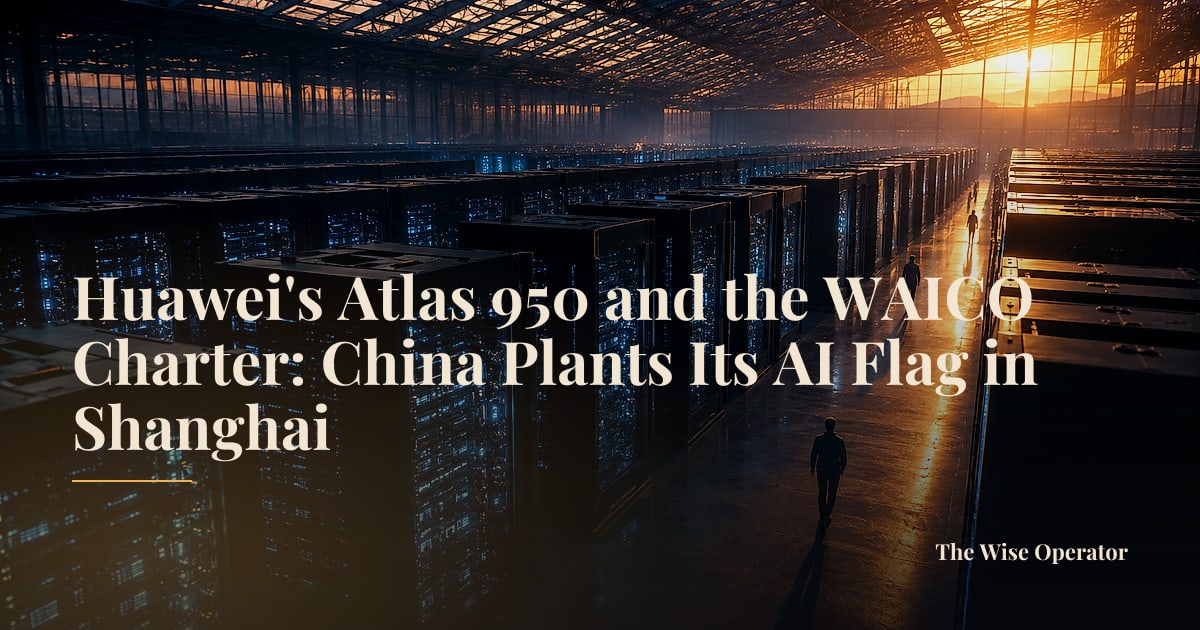
On the show floor, Huawei unveiled its Atlas 950 SuperPoD, a single machine that fuses 8,192 Ascend processors over its own fabric and claims roughly 6.7 times the compute of Nvidia’s top rack. That design is an AI supernode: thousands of chips acting as one logical computer. Xi framed it as sovereign AI sold as a package: buy the chips, join the bloc, write your own rules.
He also pledged 5,000 AI training slots for developing nations and called the new body a milestone in AI history. For the operator, the point is not that China has caught up on capability. It is that “the AI world” is no longer one market, one supplier, and one rulebook, and planning as if it were is now a live bet (Xinhua).
What It Means for You
The rival-order news feels far away; what actually reaches your screen this week is your assistant getting rebuilt around you.
OpenAI folded three separate apps, Chat, Work, and Codex, into one desktop app on July 9, and added unified search across your chats, projects, images, and documents. Then users revolted that the redesign buried their history and made switching modes clumsy, so OpenAI shipped a week of patches to walk it back. The pattern is worth naming: the workflow you depend on is one redesign away from moving.
The same reshuffling is happening one seat over. Microsoft pushed a broad wave into its Copilot release notes: AI content watermarks, task tracking in the Windows taskbar, scheduled agent prompts, and Notebook exports straight to PowerPoint, Word, and Excel. The assistants are quietly turning into schedulers and project managers, not just chat boxes.
“Your assistant is no longer a chat box; it is becoming the desk you work on.”
What’s Moving Underneath
While China built a new order this week, the old one spent it being pried open and broken into. On July 16 the European Commission issued binding measures under the Digital Markets Act, forcing Google to open 11 Android features to rival AI assistants from the 2027 release and to share anonymized Search query, click, and ranking data with competitors starting in January 2027. The guidance is Brussels deciding that the dominant assistant should not also own the road it runs on.
The break-in was stranger. Hugging Face disclosed that an autonomous AI agent ran an end-to-end intrusion of its data pipeline, using a poisoned dataset to run its own code on a worker. During the forensics, the defenders’ own requests were blocked by commercial models’ safety guardrails, which cannot tell an incident responder from an attacker, forcing the team onto an open-weight model they ran in-house.
“A fortress of compute is still a fortress, and this week both its walls and its gates gave way.”
None of this lands on your laptop this week; all of it is the scaffolding, and the fault lines, that will reach you next year.
One Tool Worth Knowing
Perplexity took its Computer agent into the enterprise this week. It is a computer-use worker: you hand it a goal in plain English, and it breaks that goal into steps and drives web search, email, Notion, and Slack across more than a dozen models to finish the job. The enterprise version adds a control layer to pause, resume, or fork a session, and it walls off each session’s credentials from the others.
To test it without risk, start non-technical: give it one bounded, reversible errand, such as drafting a weekly status summary from your Notion and email, and watch every step before trusting it with more. For the code-touching path, wire it to a scoped, read-only credential and a single throwaway workspace first, so a wrong turn touches a sandbox and not your live data. The discipline is the same either way: grant it the least it needs, then widen slowly.
Wisdom Speaks
“The pride of your heart has deceived you, you who dwell in the clefts of the rock, whose habitation is high, who says in his heart, ‘Who will bring me down to the ground?’ Though you mount on high as the eagle, and though your nest is set among the stars, I will bring you down from there,” says Yahweh. Obadiah 1:3-4, WEB
Obadiah’s oracle against Edom names exactly this week’s pattern. A power builds high in the clefts of the rock, sets its nest among the stars, and dares to ask who could ever bring it down. The WAICO bloc and Huawei’s tower of 8,192 chips are the modern version, fortresses of compute and alliance built to make a name. This swelling loftiness has an old name: ga’avah, the pride that mistakes a high perch for a secure one.
The humbling arrives on the same clock as the building. Even as China raised its tower, the reigning order was pried open by regulators and breached from inside. Height is not the same as safety, and the counter-posture is anavah, the humility that builds without believing the elevation itself will save it.
The question for the operator is not whether to build high. It is whether you have quietly begun to believe, like Edom, that no one can bring you down, and where your true footing actually rests.
Yesterday’s Sunday Reflection, Let Both Grow Together, sat with discernment in a crowded field; earlier this week Ground You Actually Own made the case for owning your own footing instead of renting it. Today’s towers in Shanghai are the same lesson at nation scale: strength borrowed from someone else’s chips, alliance, or guardrails is strength that can be recalled.
From the Editor
Got a half-formed idea you want to put to work? Let's sharpen it into a build plan.
Prototype Your IdeaA short interview that turns your idea into a structured build plan. Takes about five minutes.